Sunday, October 27, 2013

JR Newsletter: 27 October 2013 (163)

We have two contributions this week.  The first is a big announcement about small coins, and it comes from David Perkins:


Extraordinary Collection of Capped Bust Half Dimes 1829-1837 by Die Marriage and Die State to be Offered for Sale in January and August 2014

 I will be offering for sale a very nice and large collection of Capped Bust Half Dimes 1829-1837 by die marriage, beginning at the Orlando FUN Show in January 2014.  The second part of this sale is scheduled for the 2014 ANA Convention in August.  Most of the collection has been graded by PCGS, with over half of the coins having CAC stickers.   Most of the specimens grade between PCGS EF45 and MS63, with an average grade of approximately AU50.   

The collection has a total of 90 die marriages and 25 remarriages, and many coins are in unique and late die states, including a number of coins with cuds.  There are numerous Condition Census Specimens, Plate Coins from Federal Half Dimes 1792-1837 by Russell Logan & John McCloskey, and coins with important pedigrees. 
A large selection of this collection will be available for viewing at my Table #1751 at the Whitman Baltimore Coin Expo November 7-9th.   Table #1751 is listed in the program under W. David Perkins, Numismatist. 

 A listing of the coins to be sold in January 2014 at FUN should be available by early December.   
 I have included a few photos for those who like late die states and cuds:  1835 LM 5.2 with Cud (reverse), the Logan-McCloskey Plate Coin, Unique; 1835 LM 9.2 with Cud (reverse); and 1836 LM 1.2 (obverse, featuring bisecting die crack).  Editor's Note: Images are below David's contact information.

Please feel free to contact me by e-mail or phone if you would like to be included on my mailing list for this sale, or if you have any questions.

Thanks.
W. David Perkins, LM JRCS
Centennial, CO

 wdperki(at)attglobal.net

 Cell 303-902-5366
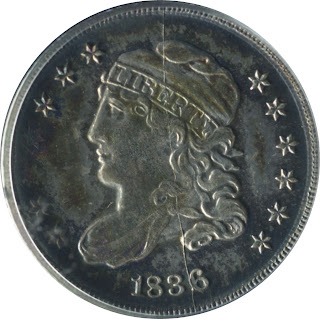

Obverse with Bisecting Die Crack:  1836 LM-1.2

Unique Die State:  1835 LM-5.2 Reverse

1835 LM-9.2 Reverse

------

Also, Nathan Markowitz wrote:

I want to remind all of the upcoming 2014 EAC/JRCS meeting to be conducted at the Doubletree hotel in Colorado Springs, CO May 1-4.  This should be a special event for the JRCS members given that the ANA is in Colorado Springs...we are working on arrangements for a special visit to the ANA during the meeting as part of the educational seminars.  Once again I am serving as the coordinator for the educational seminars and want to invite our members to give a presentation at the Colorado meeting.  Please share your interests with other collectors; I can be reached at cascades1787(at)yahoo.com.  If you have never been to the ANA don't miss this opportunity; if you have visited before you understand why you'll want to go again!

I also want to let my fellow JRCS collectors know that I have two tougher die marriage duplicates available from my early quarter collection for sale.  I have a certified VF25 1818 B-6 and a attractive VG+(not been sent in to my knowledge) 1820 B5.  If anyone has an interest in these examples please contact me at the above email...it would be great to pass them on directly to another JRCS member.


Sunday, October 20, 2013

Sunday, October 13, 2013

JR Newsletter: 13 October 2013 (161)


Alan V. Weinberg wrote:

On Friday Oct 4th I had the pleasure of  a preview examination  of the NGC-slabbed bust silver coinage at Heritage's  Beverly  Hills office- all the silver bust  quarters, bust halves and bust dollars in the Eric Newman collection, most ex- Colonel Green. 

I was amazed at the quality of the bust quarters. They did approximate the NGC slab grading in that they did not appear to have been acid-cleaned by Col Green, had original lustre and patina and beautiful National Pages toning. The stand-outs were  1806/5  B-1  MS-66, 1806  B-3  MS-65, 1807 B-2  MS- 66 CAC (green bean)  , and the eye-popping 1815 B-1  MS-67+ CAC (green bean), surely one of the finest extant  bust quarters of any date. A "wow" coin.  Also the 1833 B-2  FS-901 MS-66 CAC and the 1835 B-2 MS-67. The 1834 B-2  Proof -66+ CAC was a revelation, indisputably a proof though with a few trivial obv hairlines.

On the opposite end of the spectrum, the 1804  25c B-1 AU-55 CAC appeared to me to be no better than EF-40 with considerable circulation wear to the hair, face and shoulder (all flat!) but with beautiful old album toning but no cartwheel or lustre traces.

The slabs were in contact with each other, not separated in NGC plastic boxes which surprised me as this will undoubtedly scuff up the slab plastic surfaces, thereby obscuring the coins' details and surfaces,  as they travel to shows and are viewed in Dallas and NYC.

I then examined the bust halves and the bust dollars. The 1794-95 halves were, in my opinion, egregiously overgraded by 3-12 points with none of them exhibiting a trace of original surface, lustre or cartwheel despite grades as high as  MS-63. It has always been my impression that any mint state silver coin should have at least a trace of  lustre and cartwheel. One of the 1794 halves O-108, graded NGC Fine 12,  had a reverse eagle so faint you had to tilt the coin to see its shadow! What was NGC thinking? More like G-VG at best.

The bust dollars by and large were not the gems suggested by the  NGC slabs . The distinctive "white" 1795 draped bust off-center  B-14, BB-51  MS-66+ CAC (green bean) had a wonderful coruscating cartwheel which quite literally stopped at the large right field toning area and then continued below it. A most peculiar toning area where, I believe, the cleaning solution used by Col Green was not adequately washed off. Many of the bust dollars appeared to have been cleaned with diluted acid (as was the practice back then when commercial cleaning solutions were unavailable) by Col Green and retoned naturally in their album pages over the decades. A few exceptions stood out - the 1800 Americai MS-65 B-19 BB-192 and the single bust dollar which I think was undergraded relative to the other bust dollars (the key word is "relative") : 1802 narrow date B-6 BB-241  MS-61+ which should have been MS-63 , again relative to the other bust dollars'  NGC grades.

One wonders why NGC,  rather than the market-preferred PCGS, graded the Newman coins? Undoubtedly many buyers may try (good luck !) to  switch over . In my opinion, PCGS with its must stricter grading standards, would have been "much less kind" in grading and that may have been a primary motivation in choosing NGC over PCGS. I feel as if NGC was swayed by the old attractive toning, the Newman collection name and perhaps by the notoriety of slabbing the Newman coins. We shall see if bidders are similarly influenced by the toning and slab grades rather than the coins' actual surfaces and relief wear. Will this be an example of what I call "the emperor has no clothes" syndrome?

This writer, while never specializing in bust coinage, has been in numismatics and traveled to most of the major shows and auctions over the past 5+ decades (starting auction attendance in 1959 with the Stack's Chas Neumoyer sale and their 1960 Milton Holmes sale) so I have examined up close in hand  many of the superb federal coinage appearing for auction or on the bourse floors. I know what to expect when I see an utterly superb original surface bust silver coin that today would, for example, PCGS-slab as MS-65. I distinctly recall the superb "white" 1795 draped bust dollar in JHU/Garrett. And the toned prooflike  1796-97 Lelan Rogers half dollars.  They serve as a point of reference.

And that's my opinion.

Alan V. Weinberg  

------

Tom Little provided us with the reverse image of an1818 bust quarter he wrote about last week:


------

Alan Bricker wrote:

Of potential interest to collectors of Capped Bust Half Dimes is a selection of examples of scarce and rare die marriages currently being posted on the eBay.com website this month. To locate these eBay listings, readers can either (1) do a seller search for eBay user ID "numiscene", or (2) do a title & description key word search for "Loch Raven" under the category of Coins and Paper Money. Regrettably, any items already posted to the eBay.com platform, once listed there, are not eligible for any "private" offers or deals generated as a result of the item(s) having appeared on eBay.com. Any unsold pieces which have been listed are subject to being withdrawn at any time for any legitimate reason. To send inquiries, please feel free to use eBay messages to contact me and I will accommodate valid inquiries.

Sunday, October 6, 2013

JR Newsletter: 6 October 2013 (160)

Michael Sullivan wrote:

David Davis .... Another Memory
Our deceased friend, David Davis, was a true collector with interests ranging from early coinage, numismatic literature, maps, and early postcards.    His collection of over 600 postcards depicting Michigan railroad depots was sold at auction this past week.    While early postcards is not necesarily the pervue of the JR Journal, I did think our fellow members would appreciate the video link attached of David talking about his collecting interest from 2010.   As experienced in my many conversations and correspondences with David, he is clear, articulate, and offers insight into one of his many collecting areas.   Enjoy the video produced by his family.
 
Michael Sullivan
 
http://www.youtube.com/watch?v=wkkOLeOs6eE 


------

Tom Little wrote:

I picked up these two Bust quarters today:
 
1818/5 that is around VF and 1832 B-1 ANACS XF

 Any opinions would be welcome.
 
Tom Little
 
Editor's Note:  Photos are below.  Unfortunately, I received only obverse photos for the 1818 quarter.  Click on photos to view a larger size image.


Friday, September 27, 2013

JR Newsletter: 27 September 2013 (159)

This is the "early edition" of the JR Newsletter.  Your editor will be unavailable this weekend, so an early update to the newsletter is better than none at all.

We have one contribution this week.

Jeff Reichenberger wrote:

I currently have an 1829 LM-12 Half Dime for sale on eBay. Many of you may know the coin. I purchased it from David Kahn several years ago. If there are any JRCS members interested, please email me directly to negotiate a lower price.

Jeff
jkreichenberger (at) hotmail.com

editor's note:  Here is a link to the coin CLICK HERE

Sunday, September 22, 2013

JR Newsletter: 22 September 2013 (158)

No new contributions this week.  Please note that next week's newsletter will likely be sent out on FRIDAY, September 27th.  If you have contributions for the next newsletter, please get them to the editor by Friday morning.

Sunday, September 15, 2013

JR Newsletter: 15 September 2013 (157)


A number of contributions this week!  

Brad Karoleff wrote:

We still need a volunteer to host the next JRCS meeting at the Baltimore convention on Friday afternoon at 4 PM.

Also, if anyone wants to give a short presentation there we would be grateful.

Please let me know if you can help.   Bkaroleff (at) yahoo.com

Brad
------

Michael Sullivan wrote:

Fellow JRCS Members and, hopefully, bibliophiles -- below is an image of one my most recent project to bind my JRCS Journals.    The binding was executed by The Harcourt Bindery in Boston.   The binding is black grained cloth with dark blue spine labels including my personalization on the front board.    Bound into this set of JRCS Journals is many elements of club ephemera (supplements, voting documents for articles of the year, the club bylaws, etc.).    I would encourage any serious early coinage collector to have their set of JR Journals bound to preserve a phenomenal collection of information and insights not found in standard reference works.

For perspective, David Davis' personal set of the first ten volumes of the JR Journal bound in leather sold for $1400 in the January 2012 Kolbe-Fanning Auction.   On a personal note, I more frequent bound sets of periodicals than loose issues.    If you need some recommendations on bookbinders, contact me.

Michael Sullivan
Numisbookmjs (at) gmail.com

(editor's note:  click on the image to open a larger version of the image)

------

Louis Scuderi wrote:

JR News readers,
I am in the process of writing up some research on off center/double struck capped bust dimes, and specifically on multiple examples of the 1823 JR1. I have images of several specimens but have been unable to find an image of Russ Logan's example. This specimen was in the Bowers and Merena 2002 sale of the The Collections of Russell J. Logan & Gilbert G. Steinberg and Part III of the Jay Roe Collection and listed as Lot 2047 (1823/2 Capped Bust Dime JR-1. Rarity-3. Small E's. G-4). It was described as: 

"Double Struck. The first strike was approximately 40% off-center at 1:00 and rotated 10 counter clockwise from the final position of the second strike. Light gray with prominent hairlines and an area of brownish discoloration at center of the obverse. The reverse is weak and grades just AG-3. The reverse die crack is not visible on this example. 
Purchased August 1993 from Henry Hilgard."

Unfortunately the image attached to the lot is incorrect and has been so since the auction was first listed back in 2002. I also can not find my copy of the sale catalog.

I have two requests. First, if anyone (perhaps the current owner) has high quality images of the coin that they would be willing to share I would greatly appreciate having them and would provide acknowledgment (if desired) in the JRJ when the paper is published. Alternatively a high quality scan of the catalog might work assuming the details can be clearly seen. 

My second request is for information (and images) on any additional specimens that you might be aware of. I currently have images of three specimens:

1) PCGS - Genuine (Graffiti - AG Details) #4498.98/27972278
2) NCS - #5023211-005. 
2006 June Long Beach Signature Auction #408, Lot 1018. (1823/2 10C Small Es--Double Struck, First Strike 45% Off Center, Improperly Cleaned--NCS. Good Details).
3) PCGS mint error VG08 holder with d/so 50% o/c

If you know of any others and are willing to share information and images that would be greatly appreciated and acknowledged.
If you can help contact me at cirque1 (at) gmail.com

Thanks,
Louis Scuderi
------

Jim Matthews wrote:

I've been collecting Capped Bust dimes since the authors published the Dime reference in 1984. One of the areas that has always fascinated me was the fact that contemporary counterfeit Capped Bust dimes were also made much in the same style (and likely same counterfeiters) as the commonly seen Capped Bust half dollars of the 1820s and 1830s. One troubling aspect of the dime denomination is how frustratingly rare they are. I've usually tried to buy all I could find and have asked other specialists if they have any examples--or if they have even seen any examples! More often than not the answer is no. It would seem, given how prohibitively rare these early counterfeit dimes are, that most likely not that many were struck. Few specialists have even a single example of one of these contemporary counterfeit dimes.

I have included a picture of an 1831 contemporary counterfeit Capped Bust dime (below) that I purchased this year from another specialist who has been seeking these for many years. Notice how crude the stars are, and irregular placement especially along the right side of the obverse. Similarly the date punches are not quite right, being too small and too low, with the figures clearly a different number font than those used at the Philadelphia Mint. On the reverse, the eagle is a trifle irregular too, along with the arrows  and comical placement of the legend spacing--creating another run-on STATESOF. Nothing about this is quite right, and any dime specialist today would have no difficulty in knowing this coin was not a U.S. Mint product.

So why make a counterfeit dime? Well, for the money of course! While 10 cents today may not buy much, back in the 1830s and 1840s it certainly did. In fact for many people in these early years of our history, 50 cents was a days pay. If a counterfeiter could make enough coinage, and get it salted into circulation without being caught, there was considerable profit to be had. Today through the expertise of Keith Davignon an entire reference work has been published by him entitled "Contemporary Counterfeit Capped Bust Half Dollars" which brings to light much information on this period and offers photographs and descriptions of the various known counterfeit issues by die variety. The style, metallic content and appearance of the half dollars implies that the same makers may well have issued the counterfeit dimes as well.

We know that literacy in the general populace was certainly not that high when these were made. Thus fooling a store clerk or merchant with a counterfeit coin would have been fairly easy, certainly easy enough to continue trying given the number of counterfeit Capped Bust half dollars known today. 

I'm planning on writing a more extensive article for the John Reich Journal on each of these counterfeit early dimes that I've acquired, along with further details and photographs. Given what I've learned up to this point, there simply aren't enough coins around to do a reference work, and most seem to be unique or nearly so. I consider these to be akin to folk art, where the ungodly took their talents and created primitive dies, stirred up a batch of seething pot metal (base metals which appeared at least silver-white in color) and created planchets which could be struck. 

If any collectors have an example of one of these contemporary counterfeit Capped Bust dimes and would like to share their information with me I would appreciate it.

I can be reached at bustdollar (at) yahoo.com

Jim

 (editor's note:  click on the image to open a larger version of the image)